

IFCS Sticky Sensors for Aviation Food Carts
IFCS Sticky Sensors are installed inside carts and canisters and can remain in place for years.
Sensors transmit whenever they detect a gateway, provide warehouse equipment visibility, capture temperature readings every 5 minutes, and store readings internally when no gateway is detected.
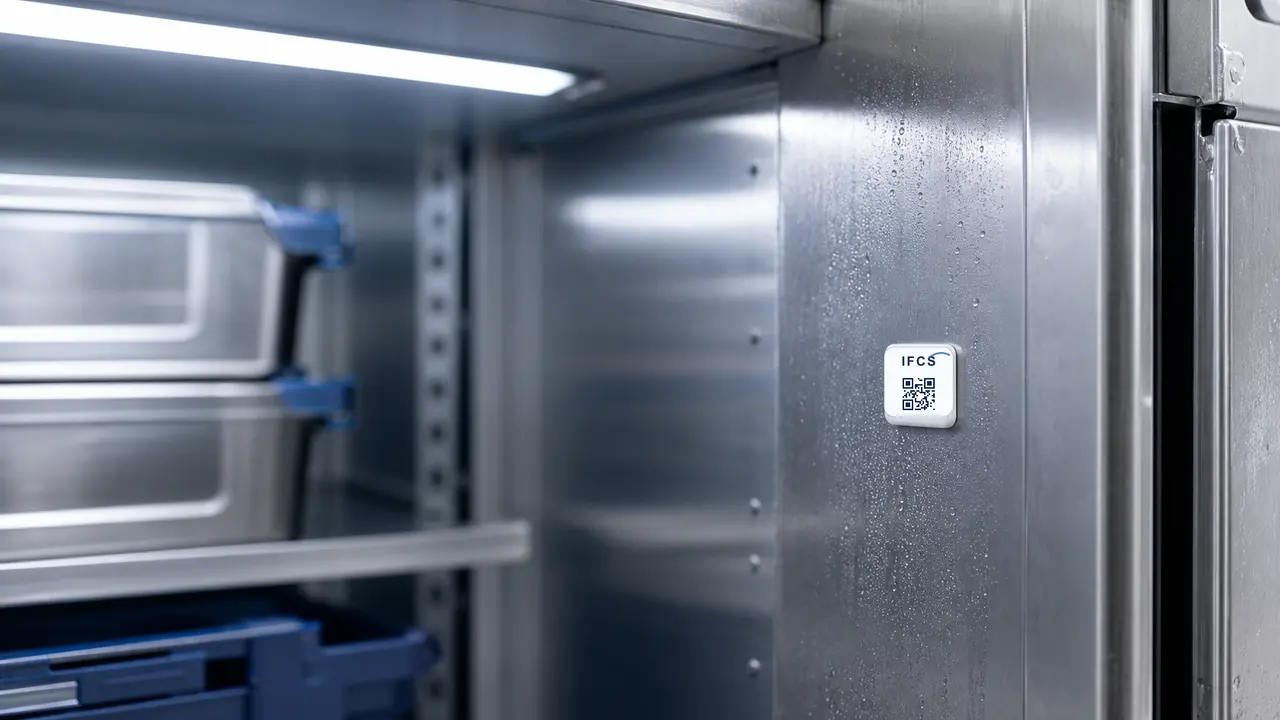
Install once. Track temperature and equipment movement for years.
Permanent temperature proof inside every cart that may carry food
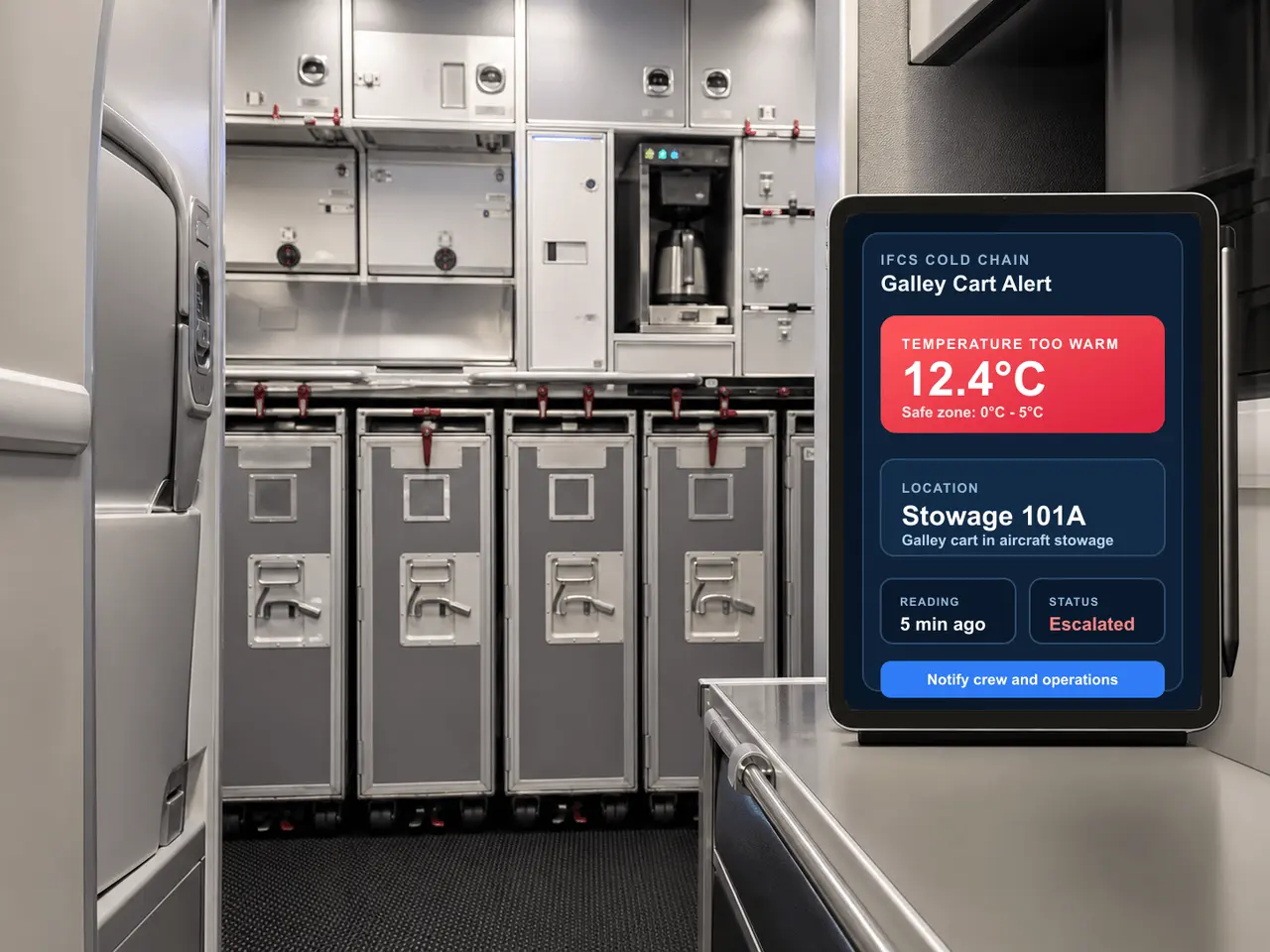
Airlines are serving more fresh food on board, but many operations still rely on dry ice, ice packs, or assumed speed between refrigerated spaces. That leaves a dangerous blind spot: no one can prove what happened inside a sealed cart after it left the warehouse.
IFCS Sticky Sensors close that gap with a permanent sensor, not a per-flight task. The sensor is installed once inside the food cart or canister and remains there for years, through normal cart handling, warehouse storage, dispatch, aircraft loading, return, and washing workflows when installed according to IFCS guidelines.
Airlines can start by placing Sticky Sensors only in food carts. Or they can place them in every cart and canister, removing the operational question of which cart gets used for food. Once the sensor is in the fleet, any monitored cart can produce the same food safety record.
Each recorded 5-minute reading becomes part of the food safety record, so the airline can prove whether the cart stayed inside its configured safe zone for the full journey.
The operational risk is highest when the process is interrupted. A delay on a hot ramp, a late aircraft, a cart left outside a refrigerated galley space, or a flight relying on ice packs can all create unsafe exposure. Sticky Sensors make those exposures visible, timestamped, and actionable.
Sealed-cart evidence
Prove every recorded 5-minute temperature point stayed inside the configured safe zone.
Airplane-mode backfill
Store readings only when the cart cannot detect a gateway, then upload the history when gateway coverage returns.
Equipment tracking
Transmit when gateways are in range, so the same sensor can help identify where carts and canisters are in the warehouse.
How IFCS Sticky Sensors work
- Install once.Attach the adhesive sensor inside selected food carts, or across every cart and canister, so monitoring stays with the equipment for years.
- Record every 5 minutes.The IFCS configuration captures cart temperature at 5-minute intervals, creating a continuous operating history for the sealed cart.
- Transmit when gateways are detected.In warehouse and other gateway-covered areas, sensors communicate whenever gateways are in range, supporting both temperature visibility and equipment tracking.
- Backfill after airplane mode.When no gateway is detected, the sensor stores temperature readings internally. When gateway coverage returns, stored readings upload into the IFCS record.
Alerts that reach the right people
Sticky Sensors transmit whenever they detect a gateway. If no gateway is detected, the sensor stores temperature readings internally during airplane mode and backfills them when gateway coverage returns.
Safe-zone deviations should not disappear into a spreadsheet. IFCS routes triggered alerts to the teams configured to receive them. Alerts appear on dashboards, flow to user notifications, and can appear in the crew app during flight where the airline has the required inflight connectivity path configured.
That makes the cold-chain record operational, not just archival. Ground teams see where the deviation occurred. Crew can be notified when action is possible. QA and compliance teams retain a timestamped event record tied to the affected cart, flight, route, and food safety workflow.
When carts and canisters are in gateway-covered areas, Sticky Sensors also transmit their presence. An airline that installs sensors across the fleet can use the same hardware for temperature monitoring and equipment tracking, with one sensor doing double duty.
- Dashboards for live oversight. Temperature status and alert history surface where operations and safety teams already monitor provisioning activity.
- Triggered notifications. Users assigned to the alert rule receive notifications when readings move outside the configured safe zone.
- Crew app visibility. Inflight alert delivery can reach the crew app when connectivity and airline configuration support that path.
- Audit trail retention. Readings and excursions remain available for review, corrective action, and compliance evidence.
Technical proof points
IFCS Sticky Sensors
Adhesive, low-profile monitoring that stays with the cart.
The data-backfill sensor variant is built for tiny, long-life, wireless temperature monitoring. IFCS installs and configures the sensor once, then integrates the readings, alerts, airplane-mode backfill, and equipment presence into the Galley XAI food safety record.
- 19 x 19 x 3.5 mmAdhesive sensor size
- -40°C to +85°CMeasurement range
- IP68Ingress protection rating
- 100,000Airplane-mode datapoints, up to
Sensor capabilities
- Install once, not every flight. Sensors stay with the cart or canister for years, so monitoring is part of the equipment instead of another flight-prep step.
- Configurable 5-minute food-cart readings. IFCS deploys Sticky Sensors for aviation carts with a 5-minute temperature reading interval.
- Airplane-mode data backfill. The sensor stores local temperature measurements only when no gateway is detected, then uploads the history after gateway coverage returns.
- Secure wireless workflow. Readings move through cloud connectors using secure wireless communication and can be integrated into IFCS workflows.
- Equipment tracking in gateway-covered areas. Because sensors transmit when gateways are in range, carts and canisters can be located in warehouse operations while the same hardware monitors temperature.
- Built for cart operations. The low-profile IP68 body is designed to withstand demanding cart environments, including normal washing workflows when installed according to IFCS guidelines.
- Calibrated accuracy option. Calibration can improve documented accuracy to +/- 0.25°C / +/- 0.45°F.
- Long-life battery design. Battery life is usage- and environment-dependent, with up to 15 years in standard operating conditions.
- Adhesive mounting. The low-profile body sticks inside cart monitoring locations without requiring cart redesign.
| Specification | Value | Why it matters for aviation catering |
|---|---|---|
| Deployment model | Installed once and left in place for years | Removes per-flight sensor handling and keeps monitoring tied to the cart or canister. |
| Cart reading interval | Configured by IFCS at 5 minutes | Creates regular proof points across warehouse storage, dispatch, flight, return, and reuse. |
| Airplane-mode storage | Up to 100,000 datapoints | Preserves temperature history only when the cart cannot detect a gateway. |
| Sensor body | 19 x 19 x 3.5 mm, 3 g, adhesive | Fits inside food-cart workflows without bulky installation hardware. |
| Operating range | -40°C to +85°C, 0 to 100% RH non-condensing | Covers refrigerated, frozen, ambient, and hot-ramp-adjacent monitoring conditions. |
| Protection | IP68 | Supports demanding cart environments, including normal washing workflows when installed according to IFCS guidelines. |
| Equipment visibility | Gateway-based transmission | Lets the same sensor support cart and canister tracking in gateway-covered warehouse areas. |
FSMA 204 Compliance Plus
FSMA 204 raises the bar for traceability, but food safety in aviation is not just a paperwork exercise. A traceability record that shows which lot moved to which flight is stronger when it also carries temperature evidence for the sealed cart that carried the food.
Sticky Sensors add that physical proof layer. Because the sensor stays with the cart or canister, its history follows the equipment rather than a single flight paperwork packet. The cart’s recorded readings, safe-zone status, gateway-visible equipment history, and alert history can support HACCP checks, corrective actions, lot-to-stowage traceability, and audit response. Instead of reconstructing what might have happened between refrigerated areas, teams can review the actual recorded temperature history.
This is why IFCS calls the workflow compliance-plus readiness: it supports the traceability rule, strengthens HACCP evidence, and helps operators answer food safety questions with data rather than assumptions.
Built for the weak points in airline catering
The most fragile cold-chain moments often happen outside the places that already have fixed refrigeration controls.
- Warehouse-to-truck dispatch. Carts can leave a controlled room before the aircraft is ready, while gateway coverage can still show where monitored carts and canisters are before they depart.
- High-loader transfer. Ramp interruptions can leave food exposed longer than planned, especially in regions where tarmac temperatures exceed 40°C.
- Aircraft loading. A cart that is not placed promptly into its assigned space can experience unsafe exposure before departure.
- Non-refrigerated galleys. Many aircraft still rely on ice packs or dry ice instead of powered refrigerated galley spaces.
- Return and reconciliation. Airplane-mode readings backfill after the cart detects a gateway again, so QA can review the full trip history.
See sealed-cart temperature proof in Galley XAI
IFCS Sticky Sensors give airlines the missing temperature evidence inside the cart itself, while also helping teams track carts and canisters when they are back in gateway-covered areas. Book a demo to see how permanent cart sensors, sealed-cart readings, alerts, airplane-mode backfill, equipment visibility, and compliance workflows connect inside Galley XAI.
Frequently Asked Questions
What are IFCS Sticky Sensors?
IFCS Sticky Sensors are small adhesive wireless temperature sensors installed inside aviation food carts and canisters. They remain installed for years, record cart temperature at configured intervals, transmit whenever a gateway is detected, and backfill stored readings after airplane-mode periods.
How often do Sticky Sensors check food cart temperature?
IFCS configures Sticky Sensors for aviation food carts to capture temperature every 5 minutes, creating a recorded timeline across warehouse storage, dispatch, aircraft loading, flight, return, and reuse.
Do airlines need to place sensors before every flight?
No. Sticky Sensors are installed once and remain installed. Airlines can place sensors only in carts used for food, or place sensors in every cart and canister so teams never need to worry about whether the selected cart is temperature-monitored.
What happens during airplane mode?
In aviation, airplane mode describes the period when the cart cannot detect a gateway. During that time, the data-backfill sensor variant stores temperature readings internally. When a gateway is detected again, the sensor uploads the stored readings, starting with the most recent samples first.
Can the same sensor track equipment?
Yes. Sticky Sensors transmit whenever they detect a gateway, so carts and canisters can be visible in gateway-covered warehouse areas. When installed across the fleet, the same sensor can support both temperature monitoring and equipment tracking.
Can Sticky Sensors withstand cart washing?
Sticky Sensors have an IP68-rated low-profile body and are designed for demanding cart environments, including normal cart washing workflows when installed according to IFCS guidelines.
How are temperature alerts handled?
When a reading moves outside the configured safe zone, IFCS routes the alert into dashboards and triggered user notifications. In flight, alerts can also appear in the crew app where the airline has the required connectivity path configured.
Does this guarantee FSMA 204 compliance?
Sticky Sensors support FSMA 204 compliance-plus readiness by adding auditable temperature evidence to the Galley XAI traceability record. They do not replace an airline's full food safety program, supplier controls, or regulatory obligations.