

The Galley · Monthly insight
The Month the Galley Changed Hands
In eight weeks, airline catering got fewer kitchens, bigger factories, longer contracts, louder software, and one very loud reminder that food still goes through a small number of hands.
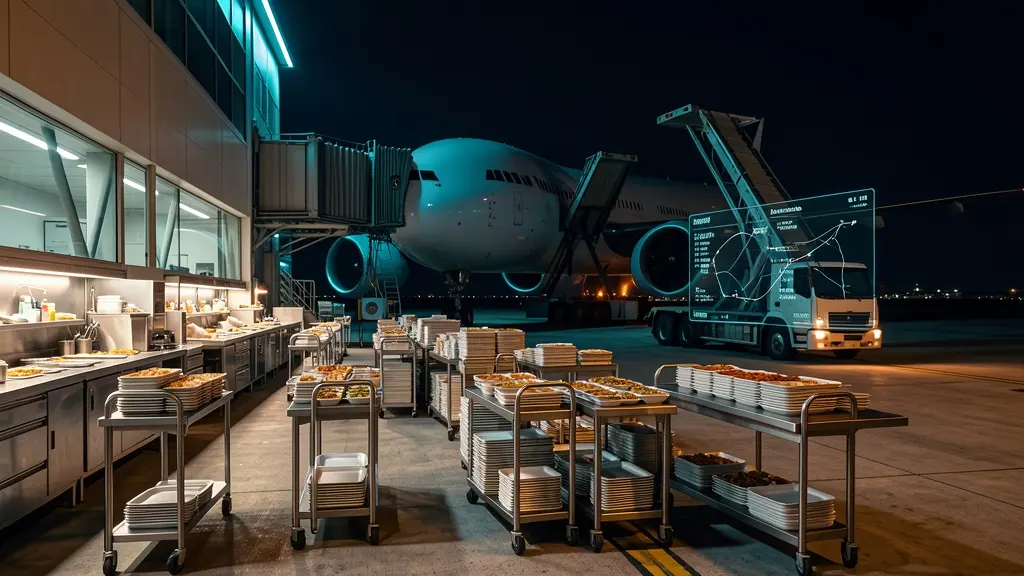
The suppliers got larger. The map got smaller.
Suddenly everyone sells catering tech. Ask better questions.
If you cannot see the operation, you are along for the ride.
At 3:12 a.m. in a hub kitchen, nobody is thinking about corporate strategy.
They are thinking about labels that stuck, carts that closed, a high loader that needs five more minutes, and a flight number with no sense of humor. Trays leave anyway. They always leave. And somewhere above the fluorescent light is a perfectly quiet fact: this summer, a surprising number of those kitchens changed owners, partners, or scale without most passengers noticing a thing.
That is the joke and the story.
Airline catering just reorganized itself in roughly eight weeks, and it did it the way this industry prefers: at industrial volume, with careful press language, and almost no fireworks in the cabin.
If you fly for a living, fly for a company, or fly for a dining department that owns risk and reputation, you should probably look up.
Welcome to Monopoly Night
June and July did not give us one big deal. They gave us a stack.
On 1 July, KLM and gategroup completed the acquisition of KLM Catering Services. gategroup took 75 percent. KLM kept 25 percent. KCS stays KLM’s caterer for the next twenty years, and a new facility at Schiphol is already in the works. That is not a handshake. That is a long marriage with a very expensive kitchen renovation.
In June, gategroup also kept rolling through Europe by absorbing LSG catering assets in Latvia and Estonia. Meanwhile Schiphol cut its ground-handling licenses from six firms down to three, with dnata holding a seven-year licence through 2033. Singapore told a similar story from the kitchen side: after adding Air Macau, dnata now caters all four Air China Group carriers at Changi, roughly 580,000 meals a year through one provider at one airport.
Then the factories got louder.
SATS is standing up a 35,000-square-metre Thailand food factory targeting about 120,000 meals a day, while also leaning harder into an AI-driven control-centre model for catering and gateway work. Air Algérie opened a 14,250-square-metre production centre built for 40,000 meals a day. These are not muffin-shop expansions. These are industrial statements.
So what?
Fewer counterparties usually means less price theater in tenders. Bigger counterparties usually bring their own systems. Longer contracts usually mean today’s data terms become tomorrow’s default for a very long time. Put those three together and you get the real plot of summer 2026: the caterer is increasingly the operating model, not just the kitchen with the clever logo on the truck.
In a consolidating market, the fancy bid spreadsheet is not your power move. Seeing your own operation is.
If an airline can independently see what was received, produced, packed, loaded, served, returned, and billed, it negotiates from facts. If it lives on monthly summaries and heroic phone calls, it negotiates from trust. Trust is lovely. Truth scales better.
One kitchen, thirty airports, no sense of humor
Then came the reminder that concentration has a pulse.
Over 8,000 Gate Gourmet workers at about 30 U.S. airports were released from federal mediation and prepared to strike as soon as 30 July, after more than six years of bargaining. The unions involved include UNITE HERE, the Teamsters, BCTGM, and RWDSU. As of this writing, the correct posture is not theater. It is readiness: a live disruption risk dense enough to matter to every carrier that depends on that network.
This is not a labor column. We are not refereeing wages, management, or who has the better press people. The operational point is simpler and colder.
When one supplier feeds cold chain into thirty airports, a labor event under one brand is not local color. It is a network problem with trays for a face.
Airlines have already seen the humbler version of this story. In 2025, United’s catering transition at San Francisco left some flights short during a provider changeover. That was not mystical. That was complexity meeting incomplete visibility.
Disruption recovery always pretends to be a logistics problem. First it is a data problem. Who has the right load list. Who knows what is missing before the crew invents a scavenger hunt. Who can replan by station, aircraft, cabin, and cutoff without discovering the truth only after the foil lid fails its public audition.
Consolidation and continuity risk are the same story seen from different ends of the loading dock.
Suddenly everybody sells a platform
While the kitchens got bigger, the software market got chatty.
Sabre spent July insisting it is “AI-first, not a legacy GDS,” even opening production travel APIs and an MCP server to outside builders. IBS Group launched Naviq as an AI-first travel tech company backed by Apax. Omnevo picked up ISO/IEC 27001 certification and quietly raised the security bar on RFPs.
Good. Seriously, good.
A market that used to feel like three dusty binders and a heroic Excel file now looks like actual grocery shopping. More names. More demos. More breathless AI adjectives. That means buyers finally have to stop nodding politely and start asking unromantic questions.
Does the system begin at receiving, or only at galley planning? Where do temperature and HACCP evidence live, and can you produce them before legal starts humming? Can it reconcile what left the kitchen against what came back? Does it invoice, or does it hand the bill to a spreadsheet with abandonment issues? Who owns the data if the catering contract changes hands on a Tuesday? What is running in production today, and where, exactly?
Galley planning is one useful stage. It is not the whole aircraft-shaped kitchen circus. We built Galley Xᴬᴵ end-to-end aviation catering control for that reason: receiving through production, loading, recovery, and invoicing. It is live today with Oman Air, Salam Air, Transom Catering, and MCT Muscat, with more than 30 airlines expected to be serviced by Galley Xᴬᴵ out of MCT before the end of this year.
Module fever is easy. Operating loops are harder. Guess which one pays rent.
The traceback that took all summer
Somewhere between the M&A notes and the schedule rewrites, food safety raised its hand like a student who had been waiting since May.
A U.S. cyclospora outbreak produced a painfully slow public lesson. Illnesses started in mid-May. A product was not named until 17 July. FDA kept its link to the implicated lettuce supply after one lab sample was retracted. Recalled product had already reached major national chains. Food Safety News put the ugly timeline in plain English: the rule that was supposed to keep this from becoming a two-month scavenger hunt did not get there in time.
That rule is FSMA 204, the Food Traceability Rule. Enforcement is now aimed at 20 July 2028, not January 2026. Two years looks generous until you remember that aviation caterers handle Food Traceability List items every day, then load them onto metal tubes that cross borders for fun.
The part that breaks good intentions is not “keep records.” Everybody has records. The part that breaks spreadsheets is producing lot-level answers in 24 hours when somebody serious asks.
Capture the lot at receiving. Carry it through production. Bind it to the flight and the cart. Keep it queryable after the aircraft comes home.
If your current system for that sequence is a folder called FINAL_v7_USE_THIS one, congratulations: you have a conversation starter and not a control system.
For the aviation-specific checklist, start here: ifcs.aero/galleyx/fsma-204-aviation-catering-software/.
The trolley is being debugged in public
And just in case the summer felt too calm, onboard retail rearranged the furniture.
SWISS is ending onboard duty-free sales on 30 September 2026 and pushing shopping online. ANA relaunched inflight duty-free pre-ordering from August departures. TUI ends complimentary alcohol in long-haul economy from 1 November 2026, leaving one beer or wine with the main meal and making everything else buy-on-board, with a £12.50 goodwill refund for people who already bought tickets under the old rules. Aer Lingus, not to be left out of the European snack renaissance, put Milano’s Margherita pizza on its Bia buy-on-board menu across short-haul flights.
Each of those decisions sounds like a product story. Every one of them is also a cart story.
What leaves the kitchen changes. What rides in the galley changes. What crew sell or do not sell changes. What comes back and needs counting changes. A service policy rewrite is a provisioning rewrite in nicer clothes.
Then Jeju Air did the interesting thing and published actual numbers. Its five-colour bibimbap accounted for 14.9 percent of international inflight food sales and ranked first on about 70 percent of routes, ordered in a 24 to 72 hour window. Air Premia opened pre-flight browsing of its retail catalogue. Different carriers, same signal: when passengers decide earlier, the operation can stop guessing so aggressively.
Unbundling rearranges the cart. Branded partners raise the standard on the cart. Duty-free exits empty part of the cart. Pre-order is the only move that also hands you better data on the way in.
Airlines used to treat the trolley like furniture. Now it looks more like software that fans, regulators, finance teams, and passengers keep force-quitting.
So what do you do on Monday?
If your catering map looks calmer this month, look again. It probably just got simpler on the surface and denser underneath.
Fewer kitchens of record. Bigger factories. Longer commitments. More software sellers with immaculate decks. And one live demonstration that food still moves through a catchable number of hands.
None of that is automatically bad news. Bigger operators can invest, standardize, and automate. New software can introduce actual choices. Retail shake-ups can improve margin math. The question is whether your own side of the table can still see the play.
Plan. Receive. Produce. Load. Serve. Recover. Reconcile. Improve.
That loop is not romantic. It is how the rest of the summer stops surprising you.
At Galley Xᴬᴵ, we like boring loops that work before the aircraft door closes. The industry can keep changing the names on the kitchen doors. Passengers will still judge lunch at 35,000 feet with the emotional maturity of a food blogger and the attention span of a group chat.
Make sure you know what you loaded. Then improve the next one.
See you next month. Try not to invent a new spreadsheet before then.