

The Galley · Monthly insight
You Picked the Fish. Now what happens ?
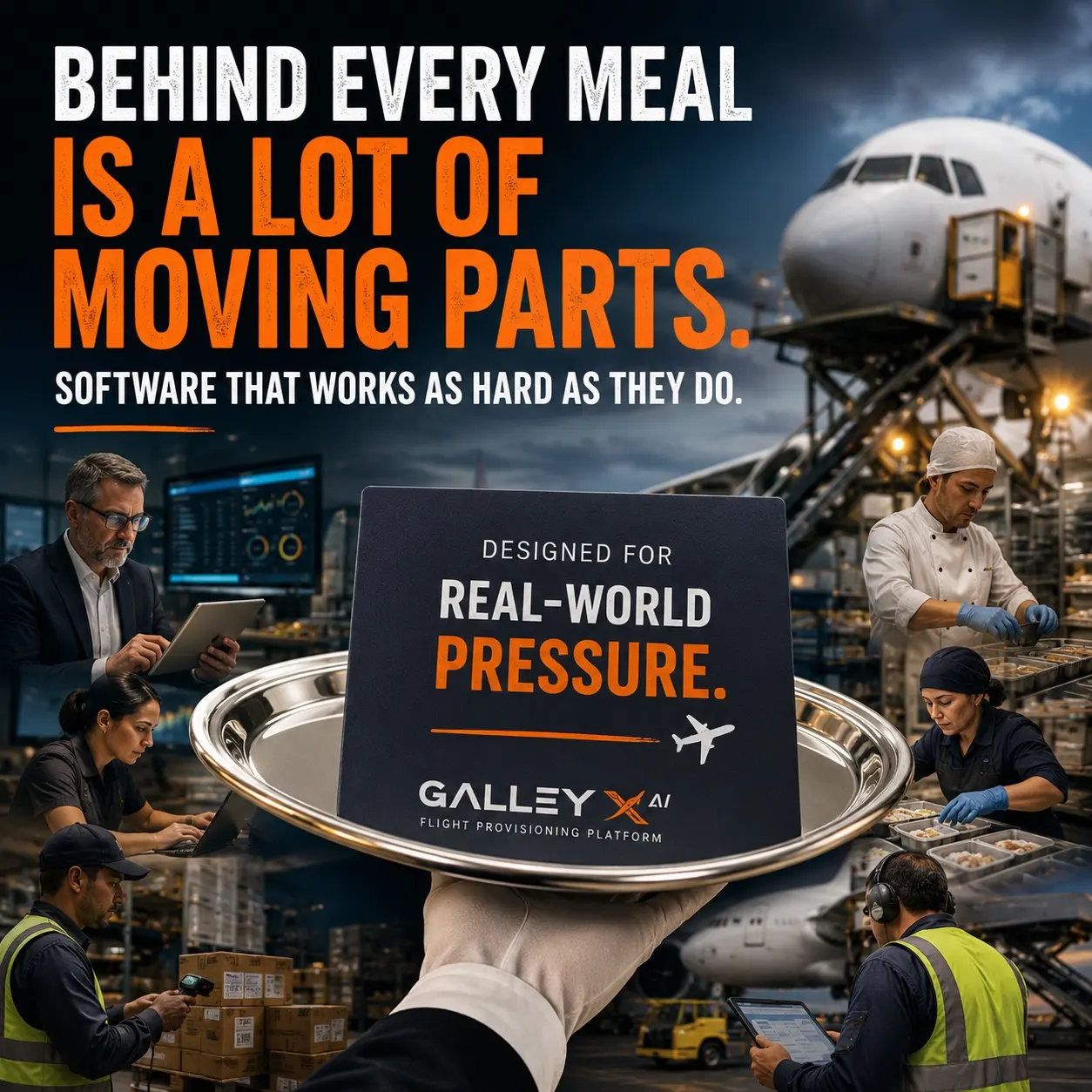
Meal preorder looks simple from seat 12A. Behind the curtain it's a relay race through apps, kitchens, carts, crew, and waste rules.
Tap. Pick. Feel civilized.
Cool. Now multiply that by route, cabin, station, cart, crew, inventory, and time.
If the data is messy, the fish becomes a crime scene.
There is a tiny moment in every flight when a passenger becomes a restaurant critic with a seatbelt.
They open the airline app. They inspect the options. They imagine themselves as the kind of person who makes good choices at altitude. Then they tap chicken, pasta, vegetarian, gluten-free, low sodium, chef-curated, or whatever beautiful little square promises not to taste like warmed-up beige.
From the passenger side, this feels delightful.
Choice. Control. A meal that did not arrive like a surprise witness.
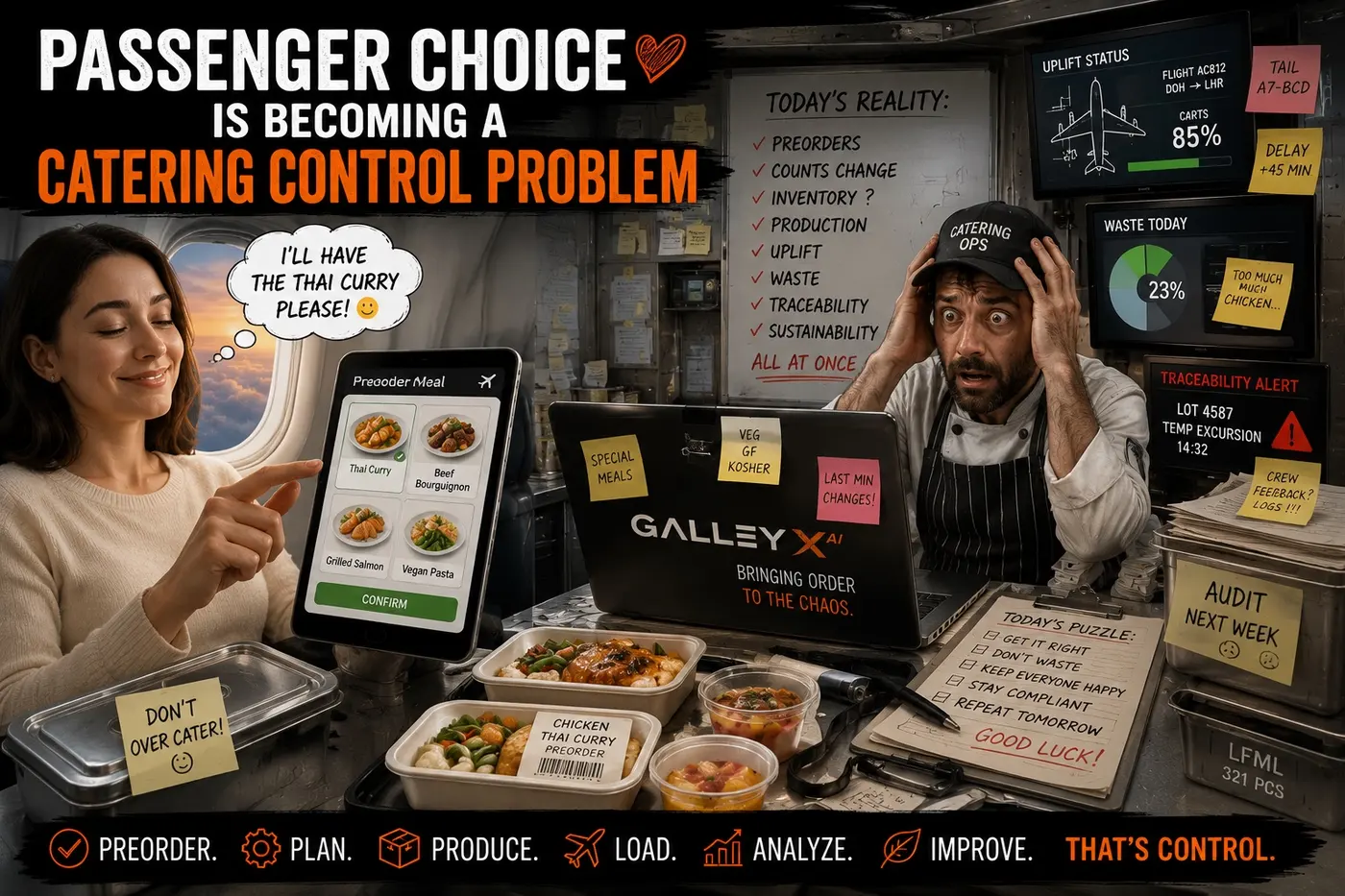
From the catering side, that tap is not a preference. It is a promise. And promises have legs. Tiny little operational legs running through airline systems, catering kitchens, inventory rooms, production schedules, packing benches, galley carts, crew devices, border rules, waste bins, and finance departments.
If any one of those legs trips, somebody in 12A gets the wrong tray.
Then your brand experience is being judged by a disappointed person holding a foil lid.
Preorder has escaped the fancy cabin
For years, preorder felt like a first-class thing.
The seat reclined into a bed. The menu used words like reduction. Someone somewhere cared about plating.
Now preorder is moving into the rest of the plane.
Hawaiian Airlines has been bringing chef-curated preorder dining into Main Cabin on select long-haul flights. Korean Air has expanded First Class preorder meals to overseas departures. Different cabins, same signal: passengers are being invited to choose earlier, and airlines are expected to remember.
That last part is doing a heroic amount of work.
It is easy to sell choice on a screen. It is much harder to make sure the right food gets built, packed, loaded, served, recorded, and reconciled without turning the catering team into a human search engine.
People say passengers do not really care about catering. Cute. Put the wrong meal in front of someone six hours into a long-haul flight and watch them develop strong opinions about the kitchen.
Airline food is boring only until it is yours, late, wrong, missing, cold, or weirdly crunchy.
The tap is the easy part
The passenger taps Fish.
Lovely.
Now the airline has to answer a few questions.
Which route? … aircraft? … menu cycle? … caterer? … cabin? … inventory lot? … allergen rule? … production cutoff? And…what last-minute aircraft swap is currently hiding in a corner laughing?
We get tired just reading that. The preorder Fish has to survive all of it.
If systems are disconnected, the operation starts doing what aviation operations always do under pressure: it invents workarounds. Someone exports a file, emails a spreadsheet, prints a list, calls the kitchen. Notes are on paper, highlights in yellow.
And then someone says, “Wait, is this the latest version?” and the room loses five minutes of its life.
Imagine in a kitchen that produces 100,000 meals a day. This is how a passenger meal becomes folklore.
Uplift data is no longer back-office trivia
Uplift used to sound like the sort of word that lived in the basement of airline operations.
Important, yes. Glamorous, no.
That is changing. Uplift data now touches passenger experience, cost control, waste, retail, crew confidence, supplier accountability, sustainability reporting, and the tiny social contract between “you chose this” and “we loaded this.”
SATS keeps signalling modernization around catering technology and uplift data through tenders. That is not exciting in a fireworks way. It is exciting in a “finally, the plumbing matters” way.
Because uplift is plumbing.
Nobody praises plumbing when it works. Everyone becomes a plumbing expert when it fails.
When that chain works, nobody applauds. They just eat.
When it fails, it fails in public, under cabin lights, with a passenger who has already decided this is going in the group chat.
Waste is where the jokes stop
Up to this point, we can joke about the fish.
Waste is less cute. IATA has been clear that cabin waste is a real aviation problem, especially international catering waste. Border and biosecurity rules can make reuse and sorting uglier than anyone wants to admit.
The easiest waste to manage is the waste you never created.
This is where preorder gets interesting. If an airline knows more about what passengers actually want before departure, it can plan smarter. Not magically. Not perfectly. But better. It can overproduce less. Pack less just in case. See patterns by route, cabin, season, station, and service model.
But preorder data sitting alone in one system is not enough if the waste data sitting somewhere else, and the Crew feedback is in emails.
But preorder is just the start of the logistics.
Traceability is joining the party
Food traceability used to be the thing people appreciated only after something went wrong.
Now it is moving closer to daily operations.
The FDA’s FSMA 204 rule is pushing more detailed traceability records for certain foods.
Translation: “Trust us, the food was fine” is not a great data strategy.
Airlines and caterers increasingly need proof. What arrived? When? From whom? At what temperature? Where did it go? What was loaded? What returned? What was wasted? What should change next time?
If the answer requires three systems, two inboxes, a WhatsApp thread, and Dave from operations because Dave “knows where things are,” the answer is not operational control.
It is Dave. And Dave probably needs a well deserved vacation.
Generic food software was not built for airplane nonsense
Airline catering is not a restaurant with wings.
A restaurant does not change aircraft at the gate. A restaurant does not load bonded inventory into a metal tube and send it across borders. A restaurant does not reconcile unused meals after landing in another jurisdiction. A restaurant does not ask a crew member to find a specific meal in a cart while 200 people listen to plastic trays rattle.
Aviation catering has route rules, cabin rules, cycle rules, security rules, customs rules, allergen rules, high-loader timing, galley maps, aircraft swaps, station differences, supplier handoffs, and passengers who somehow expect coffee to taste normal at 35,000 feet.
Generic food-service software hears that and quietly walks into the sea.
This is why the preorder conversation is really a systems conversation. The app is the cute part. The operating layer underneath decides whether the promise survives contact with Tuesday.
The Galley X view
At Galley Xᴬᴵ, we think passenger choice is a terrific idea.
We also think it is dangerous to bolt that choice onto a messy operation and hope enthusiasm will cover the gaps. Enthusiasm is not a loading instruction. Optimism is not inventory control. A really nice PDF menu is not traceability.
The next generation of catering software has to connect the loop: plan, receive, produce, pack, load, serve, recover, reconcile, and improve.
When that loop works, passengers get the choice they were promised. Crew get clarity instead of treasure maps. Caterers get cleaner production signals. Airlines get better cost and waste control. Leaders get data before the problem becomes expensive folklore.
And the fish?
The fish gets where it is supposed to go.
Which, in this industry, is basically a love story.